
Europe’s Top Destinations for 2026
January 3, 2026South America Travel in 2026
January 4, 2026
Four Seasons Explorer in Palau
When you tell people you’re going to Palau, they’re usually not sure exactly where that is. But if they are familiar with Palau, the response is generally ecstatic. Those who know Palau—generally divers, for that’s the island’s best-known activity—tend to exalt its virtues: pristine underwater environments, fascinating corals and sea life, and every shade of blue or green one can imagine, between the ocean and the dense tropical forests covering the round hills that seem to appear suddenly out of the ocean.
The Four Seasons Explorer, Palau is invariably anchored in the midst of those seascapes of blue and green. Part luxury hotel, part liveaboard dive boat, this little floating piece of heaven is almost as hard to explain—to the uninitiated—as where Palau is. It’s not a cruise, exactly (Four Seasons is developing yacht cruises which will launch next year), but it’s not a stationary floating hotel, either.
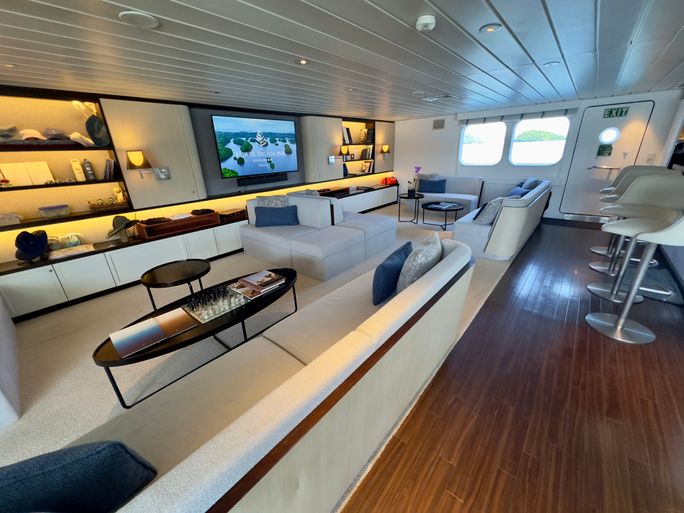
The boat changes anchor locations around the islands of Palau (there are 340 of them) once or twice a day, on a more-or-less set schedule, but the geographic footprint is small, so guests can book whatever number of nights they wish, joining or leaving the boat where ever it happens to be.
Most accurately the Four Seasons Explorer describes itself as a “floating resort with daily embarkations”. The boat’s location determines the activities on offer that day. The activities are dive-focused, and many of the other guests onboard are there for diving with the PADI-certified dive masters, but plenty of others are not.
The first morning out, we went snorkeling off a large double-decked catamaran support boat that seems half again as large as the Explorer itself. We sipped refillable glass bottles of filtered water and logged into the free Wi-Fi on the way out to the snorkeling spot, while the staff laid out the snorkeling gear we’d picked out the day before (all the loading and unloading of the gear is handled by them). Once at the snorkel spot, it was just us three guests, the guide, the dedicated videographer (we’d find out why later) and the marine inhabitants of the reef.
After lunch, it was time for a second excursion to the Milky Way, a secluded cove where the silty white limestone sand in the turquoise water makes it appear milky. As though gliding through the narrow channels wasn’t enough of a moment for social media, we arrived in a serene lagoon surrounded by limestone cliffs covered in lush foliage, where several floating docks were scattered across the surface of the water. We moored at one of the docks and our guide dove to the bottom to collect a bucket full of the white mud.
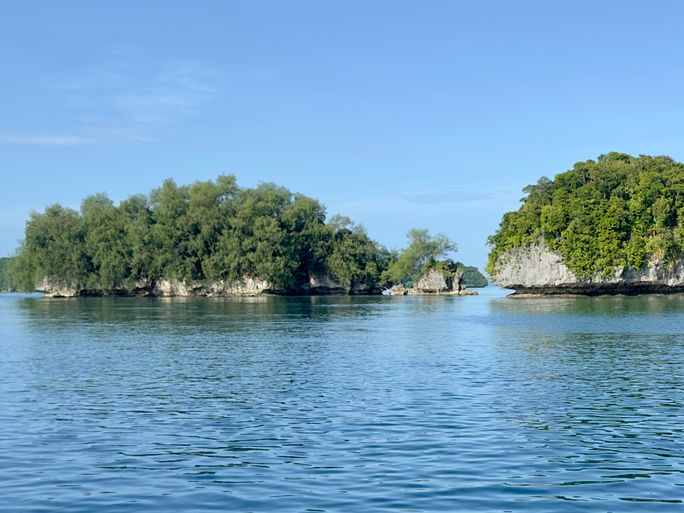
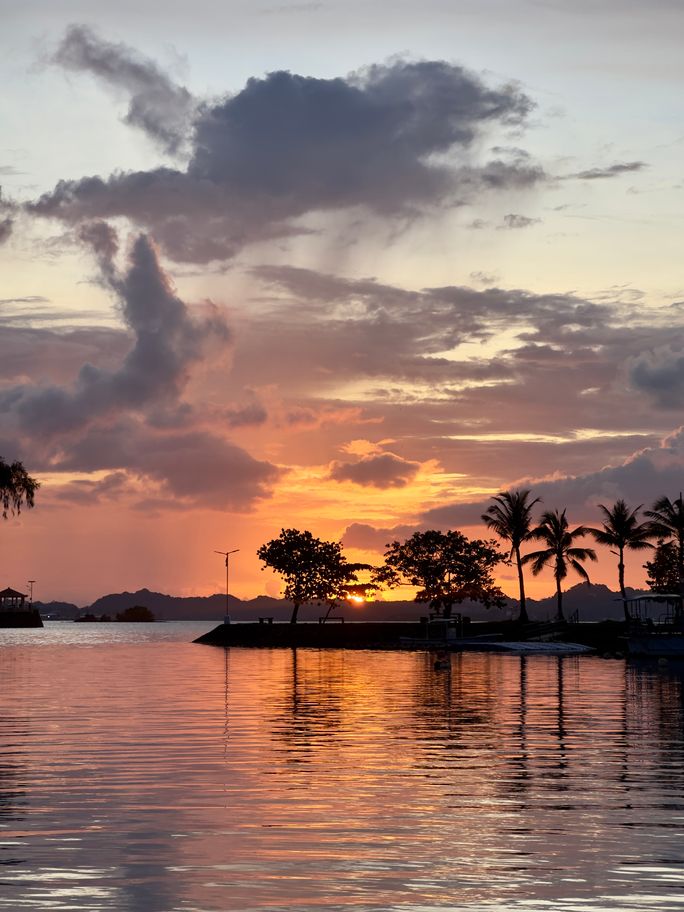
The idea is to cover yourself in the white mud and let it dry. It’s meant to exfoliate, wash away oils, and support collagen and elasticity, but it’s also rather sulfuric in aroma. In any case, it’s refreshing to step into the milky 80-degree water to rinse off and find a moment of Zen listening to just the sound of the boat bobbing in the water and the birdsong echoing off the limestone walls. On the ride back to the Explorer, we stretched out on the sun deck of the catamaran to watch as the sun dipped low on the horizon.
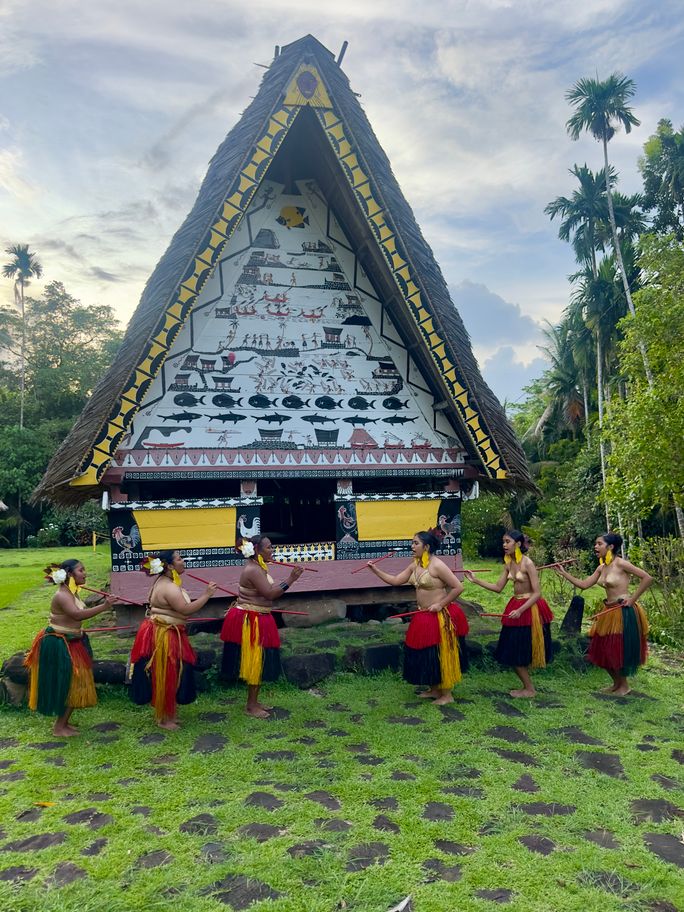
There was no typical day on board, with something a bit different each morning. One day, we transferred to Koror to board Four Seasons vans (robustly air-conditioned, with Wi-Fi) to visit a hatchery for local sea life, both to stock the local lagoons and to ship abroad for aquariums. After this, we visited a hundred-year-old Palauan bai (meeting house) for a dance demonstration by local women, with canapés and cocktails provided by the Four Seasons staff.
It’s almost hard to believe that these islands were some of the most fiercely contested during World War II. To the south lies the island of Peleliu, site of some of the most intense combat between U.S. Marines and Japanese forces in the autumn of 1944. Today, there’s a museum, and around each island are ruins of fortifications and administrative buildings built during the Japanese occupation.
Each time we returned to the Explorer, we were greeted with scented towels (cold when it was sunny, hot when we were in the midst of a rain shower) and fruit juices. One thing you won’t feel onboard is crowded. There are just ten guest rooms and one suite, each of which is equipped with Four Seasons bedding, a full bath with rainfall shower (the Explorer Suite also has a bathtub), a minibar and amenities standard in any Four Seasons Hotel anywhere else in the world.
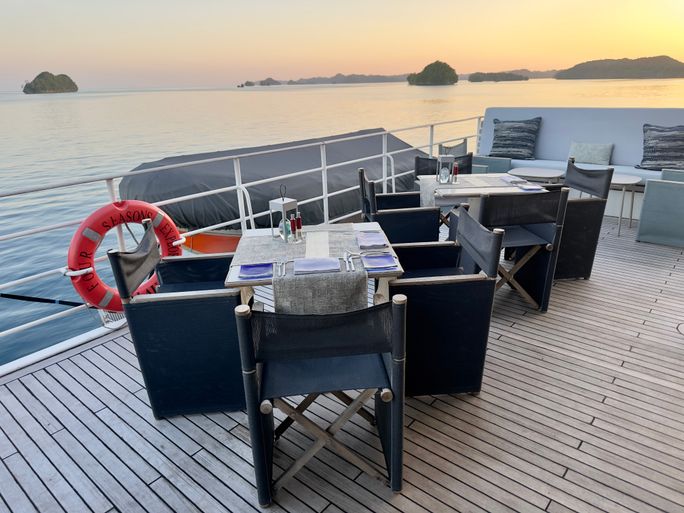
We were also well-fed. Each evening, there was a different regional theme for dinner— there were evenings of Indian, Vietnamese and European cuisine, with delightful three-course meals with a choice between two main dishes. Meals could be taken either in the air-conditioned dining room or out on the aft deck—a preference of most of the guests for breakfasts each morning with the backdrop of a brilliant sunrise while tucking into a plate of Palauan banana pancakes.
Each evening, the ship’s company gathered in the lounge to view a video recap of the day—a chance not only to catch a glimpse of oneself, but also to see what sort of fun was had by t.hose who went diving or did other activities. We enjoyed overhead drone footage of our visit to Milky Way, as well as underwater shots of us snorkeling and exploring the reef. The divers had it a bit better, poking around shipwrecks and downed fighter aircraft from the war. After enjoying the video recap each evening, we were presented with a copy of the videos from our stay to take home.
Palau itself is very accessible for American travelers, despite the differences. The country is in free association with the United States, meaning that it’s fully independent, but is closely connected with the U.S. Palau uses the U.S. Dollar as its currency, is serviced by the U.S. Postal Service and receives federal funding programs and defense from the United States.
United Airlines serves Palau from its hubs in Guam and Tokyo Narita, with onward connections to the U.S. China Airlines also offers service from Taipei.
Although it was a long journey across the Pacific, visiting both Palau and the Four Seasons Explorer felt well worth the time investment. Perhaps the biggest worry I had the entire week was plotting out my rationale for returning home.
This article originally appeared in TravelPulse.
Contact My Journey Begins Travel to book youre cabin on Four Seasons Explorer in Palau.